OpenAI: Plotting to Use a Latticework of Models

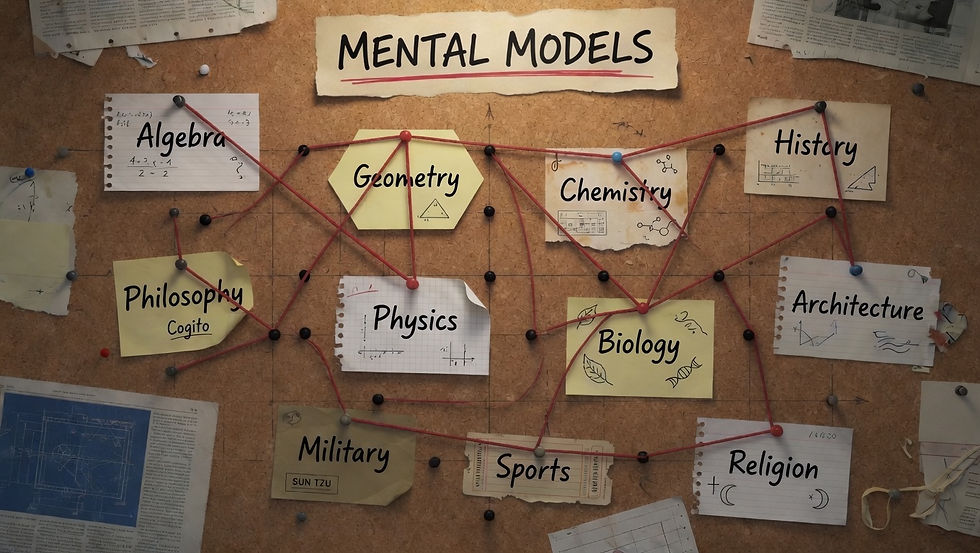
OpenAI recently announced that one of its models had disproved the “Erdős Unit Distance Conjecture,” a challenge that has stumped the world’s best mathematicians since 1946.
Lateral thinking made the difference, an idea with direct application for investors.
I will leave discussion of the 125-page proof to others. Ben Cohen's article in The Wall Street Journal does an excellent job of summarizing the topic.
The gist of it is the search for the optimal latticework of dots, or points, to maximize the number of adjacent connections among them. AI took the novel step of borrowing from algebraic number theory, an alternative branch of mathematics, to tackle a geometry problem.
Charlie Munger once said, “[T]he first rule is that you can’t really know anything if you just remember isolated facts and try to bang ‘em back. If the facts don’t hang together on a latticework of theory, you don’t have them in a usable form. You’ve got to have mental models in your head. And you’ve got to array your experience, both vicarious and direct, on this latticework of models.”
Borrowing from other disciplines helps avoid what Munger dubbed “man-with-a-hammer syndrome” where every problem is tackled with the same narrow toolset. For this reason, investment markets borrow heavily from other domains. Much of our terminology originated outside of finance: catalysts from chemistry, ecosystem from biology, momentum from physics, and leverage from engineering.
One man’s mental model is another’s heuristic. Rely too heavily on mental shortcuts and you hit a dead end. But array ideas from a range of disciplines on a latticework of models, and new paths appear. That is where edge and alpha are found.
Mental models have a dedicated chapter in my forthcoming book, Running Against the Herd.


Comments